|
Canadian
Navy Timeline
The Beartrap - A Canadian Invention
Originally
published in Crowsnest Magazine - Vol 17, Nos 3 and 4 March-April
1965
 |
|
A
Sea King helicopter begins its approach to the flight deck
of the Assiniboine. Flight deck crewmen wait beside the beartrop
device. (DNS.33910)
|
THE
PILOT moves the helicopter slowly ahead, keeping pace with the ship.
He is about 50 feet above a heaving, rolling deck. He releases a
thin wire messenger. It brings back a heavier wire from the flight
deck. The slack is taken upit tightens. Slowly the helicopter
descends on its umbilical cord. The descent quickens.
As the helicopter touches down, steel jaws grip it.
What
is this?
Beartrap
they call it the new haul-down system for landing helicopters
on destroyer escorts.
Why
is it?
 |
|
A
flight deck crewman grounds the messenger while the other
prepares to connect the hauldown cable. The Sea King hovers
about 50 feet above the deck. (DNS.33897)
|
Basically,
to make possible the landing and securing of heavy helicopters on
destroyer-size ships in rough weather.
The
project had its beginnings nearly 10 years ago, when the helicopter-destroyer
combination was selected by the Royal Canadian Navy as a promising
antidote to the high-performance nuclear submarine.
To
start with, the Navy fitted a small, experimental flight deck to
a frigate, HMCS Buckingham. Trials were successfully carried out,
using a Sikorsky HO4S-3 helicopter. The next move was to put a platform
on the destroyer escort HMCS Ottawa. Further trials were conducted,
using an RCAF Sikorsky S-58. On the basis of the trials, the concept
of operating helicopters from destroyers was recommended and received
approval in principle.
Two
things were needed. One was a helicopter capable of all-weather
day and night operation (the HO4S-3 was not). The other was a system
for handling and securing a helicopter on a small flight deck in
rough seas.
The
former was found, in the 9.5 ton Sikorsky CHSS-2 Sea King. The landing-handling
problem was solved by the beartrap.
During
the trials, it was found that landing was not so much a problem
as was the handling of the helicopter after it had landed. Manhandling
was neither quick enough nor certain enough to establish the measure
of control necessary to ensure that, in certain circumstances, the
helicopter will not take charge, and go over the side.
The
Navy went to the drawing boards and came up with a scheme that promised
to make the concept practicable. Conceived by the RCN, the haul-down
and beartrap system was engineered by Fairey Aviation, Dartmouth,
N.S. A prototype was designed and built by Fairey, under RCN supervision,
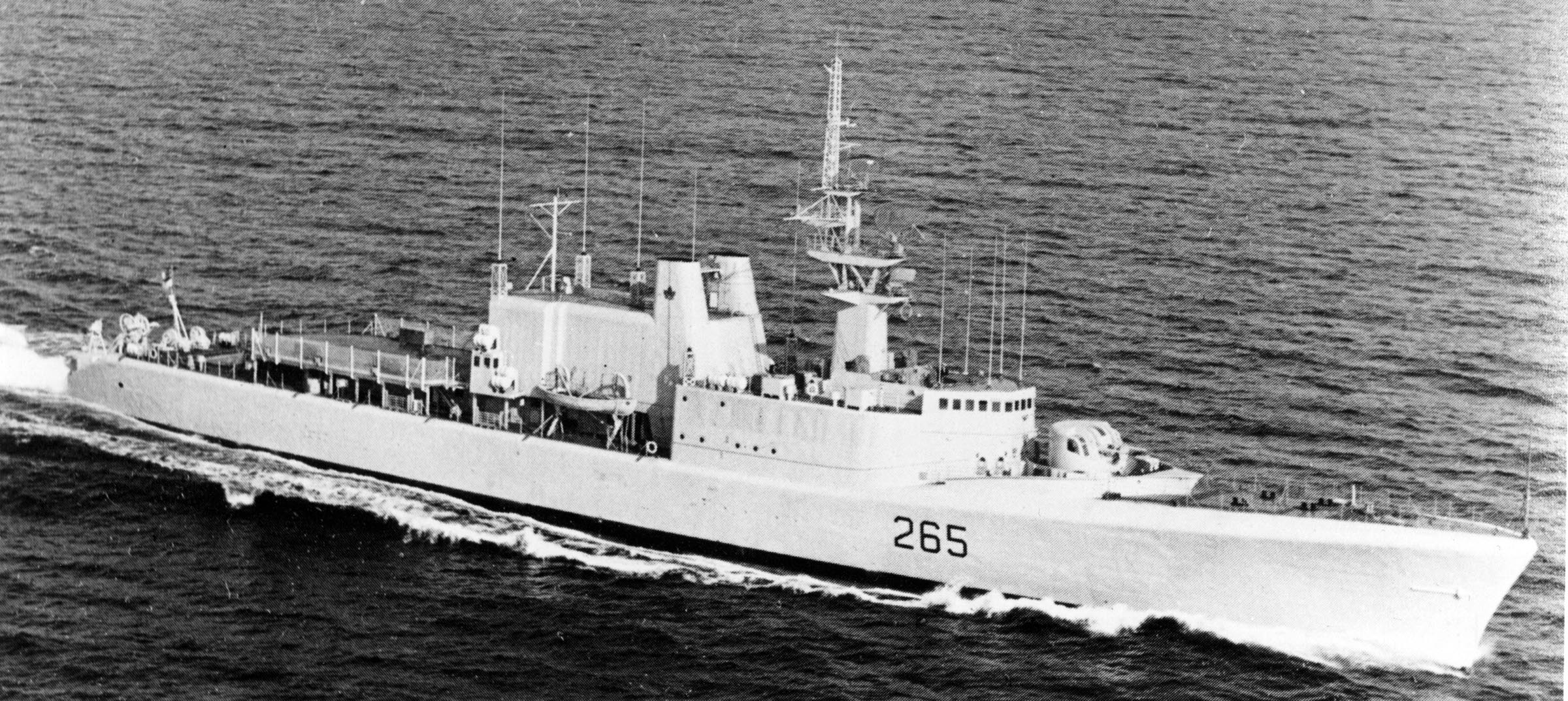
and was installed in HMCS Assiniboine during her 1962-63 conversion.
 |
|
This
is "beartrap", a rapid securing device, which, with
the coiled haul down cable, lies ready for the landing operation.
Flight deck personnel will grab a messenger cable from the
helicopter. (HS.75928)
|
 |
|
Amid
multi-wired cables, the landing control officer prepares to
haul down the tethered Sea King. The LCO is constantly in
radio voice contact with the helicopter pilot. (CN-6826)
|
Trials
with a newly-acquired Sea King began late in 1963. By mid-1964 the
daytime trials were completed and pronounced successful. Using the
new system, no manhandling was needed to get the helicopter on the
deck and in or out of the hangar. The helicopter was solidly secured
on landing and remained so until the next take-off.
In
conjunction with the helicopter carrying features and hangar facilities,
roll-damping fins were added to the destroyers being so built or
converted. These fins reduce the roll of the ship and aid landing
and take-off operations during rough weather.
An
average landing doesnt take any more than five minutes from
approach to the snapping shut of the beartrap. The approach is made
from the stern of the ship. When in position, an operator in the
helicopter lowers a wire rope messenger. To this messenger a man
on the flight deck attaches a heavier hauldown cable. (A pair of
grounded tongs discharges any static electricity in the messenger
so that the man wont get a rude jolt.) The messenger and hauldown
cable then are drawn into the helicopter through a probe in the
helicopters belly. After the haul-down cable has been locked
in position inside the probe, the slack in the cable is taken up.
A landing control officer (LCO) on the flight deck controls the
haul-down and landing from this point onward.
The
pilot keeps his helicopter hovering in the correct position over
the trap. Like an angler reeling in a jumping trout, the LCO slowly
begins to reel in the helicopter. The LCO regulates the rate of
descent of the helicopter on the control console. When it is in
a position just off the deck, he can then increase the rate during
a lull in the ships motion. He plays the helicopter quickly
into the beartrap where steel jaws snap around the probe and hold
the chopper securely against any motion the ship might
offer.
This
operation can be performed with the ship rolling as much as 310
and with pitching motion as much as 8°.
Breaking
the system into its component parts, the largest and most complex
arc in the destroyer escorts, with the lightest and smallest in
the helicopter.
The
helicopter contains the main probe, a tube-like structure protruding
from the underside of the fuselage, through which the messenger
cable is paid in and out. The winch operating the messenger sits
on top of the probe, and is controlled by an operatur in the helicopter.
The probe incorporates pins to engage the haul-down cable and lock
it in position. A series of micro-switches then actuate the locks,
disengage the messenger from the haul-down cable, and stop the winch
when the messenger has completed its work.
 |
|
Beartrap
jaws grip the Sea Kings probe, clamping the 9.5-ton
chopper firmly on deck. The helicopter thus is
poised for centring and shifting into the hangar. (CN.6823)
|
Destroyer
equipment is divided into three sectionswinch unit, power
unit and beartrap rapid securing device.
Motive power for the system comes from a 60 hp electric motor. This
operates a hydraulic pump and motor which in turn actuate a double
drum winch through reduction gears. Each drum is operated independently
and has its own clutch and braking system. The entire hydraulic
system operates at 3,000 psi and is rated at 4,000 psi.
The
system maintains constant tension in the haul-down cable. This is
of great importance for, without it, the helicopter would be dragged
down and jerked drastically whenever the ship pitched to any appreciable
degree.
Constant
tension in the cable is ma intamed by an intricate system of black
boxes, or modules. Basically, they compare selected tension
on the control console with actual cable tension. The difference
is measured and fed to a valve which controls the paying in or out
of cable. The sensing devices, in company with the five control
modules which make up the constant tension equipment, are so sensitive
to change that narrow limits are achieved even in the roughest of
weather conditions.
A shock
absorber is built into the system as well, to absorb snatch loads
in cable tension. These loads occur particularly when the slack
in the cable is being taken in before haul-down. The shock absorber
is a piston-cylinder arrangement with double sheaves on either end
around which the haul-down cable passes. The cylinder is charged
with air under pressure.
The beartrap rapid securing device sits in a slot in the flight
deck and travels fore and aft in response to a command signal from
the LCOs control console. It secures the helicopter immediately
upon landing by engaging the main helicopter probe.
The
six-foot square beartrap secures the helicopter when the LCO pneumatically
fires two parallel beams equipped with steel, spring-loaded teeth.
The beams prevent the probe from moving port or starboard and the
teeth prevent probe movement fore and aft. The end of the probe
is swaged so that it cant jump out of the beartrap.
The
beartrap has a centring device. Centring is accomplished by traversing
the beartrap unit aft. The beams are equipped with a fail-safe device
which keeps them together in case of system failure.
The
entire beartrap mechanism travels in a slot along the centre-line
of the flight deck. It can be traversed with its captive helicopter
the full length of the flight deck, in or out of the hangar. This
eliminates the dangerous manhandling problems which could exist
with a 9.5-ton aircraft, particularly in rough seas.
While
the haul-down cable is operated from one of the twin drums on the
winch unit, the traversing system is controlled by the other.
With
the landing complete the LCO centres the helicopter, the rotor blades
and tail pylon are folded by the pilot and the helicopter is stowed
in the hangar.
Safety
and ease of handling are the keynotes in this system. Day landing
trials on the Assiniboine were completed last summer and Experimental
Squadron 10 (VX 10) pilots have begun a series of night landing
trials.
|